
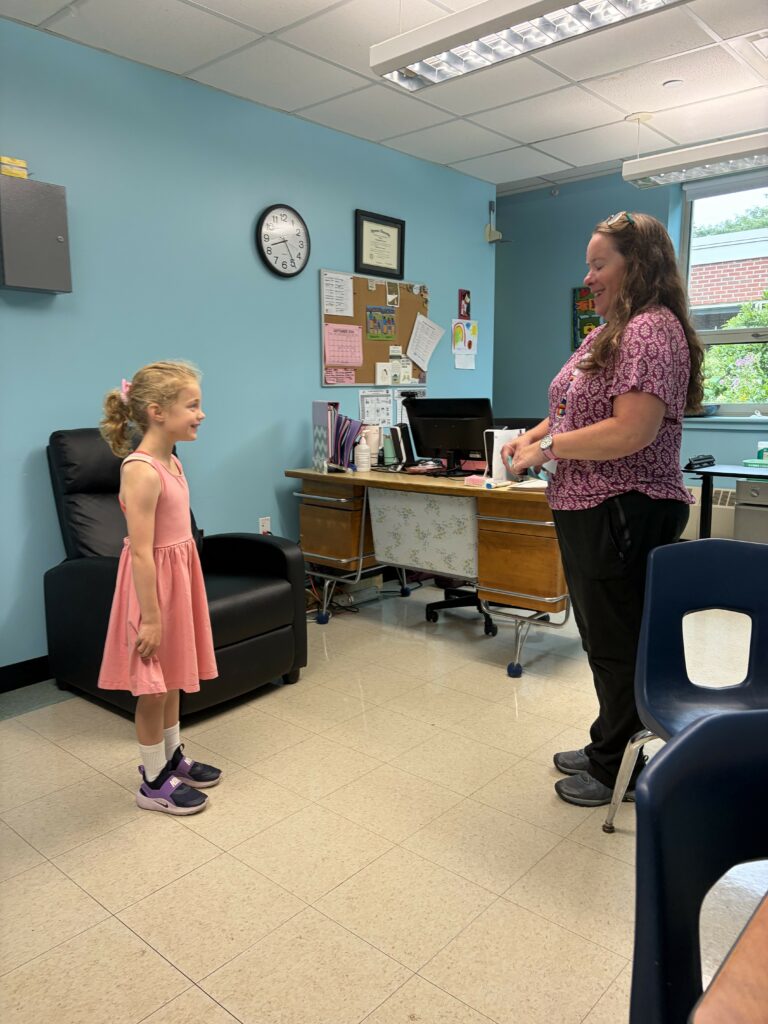
BSD is proud to have 10 full-time School Nurses in our elementary, middle, and high school buildings, as is recommended by the National School Nurses’ Association. BSD also follows the Vermont Department of Health (VDH) Nurse Leader Model, employing a full-time District Lead School Nurse to support student health.
As the only medical professionals in our buildings, School Nurses follow VDH and Vermont Agency of Education (AOE) directives. School Nurses are dually licensed with a Registered Nurse License from the Office of Professional Regulation’s VT Board of Nursing, as well as an Educator’s License with School Nurse Endorsement from the AOE.
School Nurses act as an important part of various support and safety teams in our schools. School Nurses perform health assessments, first aid, emergency care, administer medications, create emergency medical plans, conduct state-required vision and hearing screening, as week as provide health counseling, case management, and support services to students and families as needed. School Nurses work with students and families to optimize individual health while at school. (Check out the 5 Ways School Nurses Benefit Their Schools.)
You will find more information about Health below. These topics are listed alphabetically for ease of searching for a specific topic.
P.S. Healthy students are better learners. The American Academy of Pediatrics’ Bright Futures recommends an annual well-child exam to address the physical, social and emotional needs of students. Doing so promotes attendance, enhances the student’s ability to fully access and enjoy the educational experience, and promotes better academic outcomes.
Most families whose children require medication can give it to them at home. According to BSD Medication Administration Procedures, any and all medications that are to be given to students during the school day need to be turned in to the school nurse by an adult in the family. Prescription and over-the-counter medication will be given to students in the nurse’s office only with a doctor’s orders. Prescription medications will not be given without an up-to-date Medication Administration Form on file. Medication is only given by the school nurse or faculty/staff who are specially trained by the school nurse. Medication is never kept in classrooms or in students’ possession. All medication in our schools is locked and stored safely according to law.
All families must fill out the health information section of the New or Returning Student Registration in PowerSchool each year to ensure that nurses have the most up-to-date information of health status, immunizations, medications, and emergency contact information for each student. If this information is not updated at the beginning of each school year, your student may not participate in field trips off of school grounds.
According to the American Academy of Pediatrics, 6-12 million children will get head lice this year. BSD’s stance, provided annually to parents through the Wall Calendar and Family Handbook, is that “Parents should check their young children’s heads once a week and especially before returning to school after vacations.” If you find lice, your school nurse or health care practitioner can give you good advice about getting rid of them. Consistent and frequent combing of damp hair is the most effective way to treat head lice. If your child is found to have head lice at school, you will be notified. BSD follows the guidelines of the National Association of School Nurses’ Head Lice Management in Schools, Vermont Dept. of Health and the CDC. For more information, refer to: Head Lice FAQ and/or Consumer Reports, or contact your school nurse if you need any help or have any questions!
Remember, head lice can only survive for 24 hours when farther than ¼” away from the scalp. For more information, refer to these resources:
- UVM Medical Center Health Library: Head Lice
- AAP’s healthychildren.org: Head Lice: What Parents Need to Know
- Please note: Because adult head lice do not survive for more than 24 hours when more than ¼” from the scalp, and eggs do not survive when more than 6 mm away from the scalp, bagging items for up to two weeks is NOT recommended.
- CDC: About Head Lice
By law, all students must meet immunization requirements or have an exemption on file when registering for the school year. Exemptions need to be signed yearly per state requirements. A list of required immunizations can be found in BSD’s Immunization of Students Protocol (Coming Soon!). Please review the Vermont Department of Health Immunization Regulations for more information. The Vermont Department of Health website provides the most up-to-date information and resources on vaccinations, including annual vaccination rate data, school vaccination requirements, information on exemptions, and exemption forms. Please reach out to your School Nurse with any questions!
VCHIP Immunization Information for Parents/Guardians can be a helpful resource as well.
Puberty is a time filled with complex changes in the body. We encourage families to talk regularly and openly with their children, starting as early as 3rd grade through grade 12, about what they can expect and how their bodies will change as they grow older. While this information is part of the school district’s middle and high school health curricula, it is important for students to talk through this sensitive health topic with their trusted adults at home.
Here are some age appropriate books focusing on changing bodies. Most are available through the public library system or available online for purchase.
- The Care and Keeping of You 1 – The Body Book for Younger Girls (American Girl Library), Valerie Schaefer
- The Care and Keeping of You 2 – The Body Book for Older Girls (American Girl Library), Dr. Cara Natterson
- Ready, Set, Grow!: A “What’s Happening to My Body?” Book for Younger Girls, by Lynda Madaras
- On Your Mark, Get Set, Grow!:A “What’s Happening to my Body?” Book for Younger Boys, Lynda Madaras
- What’s the Big Secret? Talking About Sex With Girls and Boys, Laurie Krasny Brown
- It’s Perfectly Normal: Changing Bodies, Growing Up, Sex and Sexual Health, Robie H. Harris
- It’s So Amazing!: A Book about Eggs, Sperm, Birth, Babies and Families, Robie H. Harris
- The Feelings Book: The Care and Keeping of Your Emotions (American Girl Library), Dr. Lynda Madison
- Where Did I Come From? The facts of life without any nonsense, Peter Mayle
- What’s Happening to Me? An Illustrated Guide to Puberty, Peter Mayle
- What’s Happening to My Body? Book for Boys, Lynda Madaras (age 9-15)
- It’s Not the Stork!: A Book About Girls, Boys, Babies, Bodies, Families and Friends, Robie H. Harris
- The Girl’s Body Book: Everything You Need To Know For Growing Up YOU!, Kelly Dunham and Laura Tallardy
- The Boy’s Body Book: Everything You Need To Know For Growing Up YOU!, Kelly Dunham and Steven Bjorkman
- Protecting the Gift, Keeping Children and Teenagers Safe (and Parent’s Sane), Gavin De Becker (Safety and Sexual Abuse Prevention)
Recommended for Ages 10 and up
- It’s Perfectly Normal! Changing bodies, growing up, sex and sexual health, Robie Harris and Michael Emberley
- The “What’s Happening to My Body?” Book for Girls, Lynda Madaras with Area Madaras
- What’s Going On Down There? Anwsers to Questions Boys Find Hard to Ask, Karen Gravelle with Nick and Chava Castro
- Changing Bodies – Changing Lives, Ruth Bell and others (14+)
- Body Drama – Real Girls, Real Bodies, Real Issues, Real Anwsers, Nanct Redd (14+)
- GLBTQ: THe Survival Guide for Queer and Questioning Teens, Kelly Huegel and Steven Cozza
- The TALK – What you kids need to hear from you about sex, Sharon Maxwell, PH.D.
- Period. A Girl’s Guide, JoAnne Loulan and Bonnie Worthen
- The Period Book: A Girl’s Guide to Growing Up, Jennifer Gravelle and Debbie Palen
- Will Puberty Last My Whole Life? REAL anwsers to REAL Questions from Preteens about Body Changes, Sex and other Growing Up Stuff, Julie Metzger and Robert Lehman
- Before She Gets Her Period: Talking with your daughter about menstruation, Jessica Gillooly
BSD has partnered with Community Health Centers of Burlington to provide a school dental program for over 20 years. This program began when no dental providers in the state were taking Medicare as a means for BSD students who had Dr. Dynasaur state Medicaid to care for their dental needs.
All children who are Burlington School District students or siblings of students, who are enrolled in Medicaid, Dr. Dynasaur or are low-income and uninsured and have not seen a dentist in the past year, are welcome. If you are low-income and uninsured, we’ll help you meet with our Patient Support staff to apply for programs and/or our Sliding-Fee Scale Program.
Getting started is easy. Simply, fill out the School-Based Dental Center Medical/Dental History Form (one for each child), sign it, and send it back to your School Nurse. If you do not have access to a printer to fill out this form, CHC’s School-Based Dental Center staff can help you fill out the form; just call CHC’s Dental Center’s main telephone number 802-652-1050 for assistance.
Once your child is signed up, the school and CHCB’s Dental Center will take care of everything else for you. Remember, parents/guardians are always invited to dental appointments, too.
Our School-Based Dental Center offers:
- Cleanings and Check-ups
- Fillings and Sealants
- SSTA Transportation
- Interpreters Services
- Goodie Bags
Tips for a healthy smile at any age:
- Brush and floss every day to remove food and germs.
- Use fluoride toothpaste. Use only a pea-sized drop for young children. Toothpaste should not be swallowed!
- Eat healthy foods and snacks.
- Don’t put your baby to bed with a bottle.
- Make regular dental check-ups for the whole family.
BSD has partnered with University of Vermont Medical Center Pediatrics Primary Care to provide a School-Based Health Center (SBHC) for over 20 years. Visits are via virtual appointments for students K-12 and in-person appointments for Burlington High School students. To take advantage of the SBHC, parents/guardians must sign their student up for the service using this School-Based Health Center Registration Form. Parents/Guardians may apply for up to four children/students on one registration form. Feel free to print and return the completed form to the School Nurse at your school. If you do not have printer access, your School Nurse can print a form to send home with your student.
Services Include:
- Sick visits (colds/flu, skin rashes, stomach illness, ear infections)
- Assessment and care for chronic illnesses such as asthma, allergies, ADHD etc.
- Behavioral, psychosocial, nutritional issues
- Family outreach and support.
Program Details:
- Participation is voluntary.
- There is an application which needs to be filled out before the first visit.
- The clinic providers will communicate with your child’s primary doctor by confidentially sharing visit notes whenever your child is seen in the clinic.
- Parents/Guardians are always welcome to attend appointments, but it is not required. If you can’t make it in person or virtually, the primary care provider will try to reach you by phone.
- If Medicaid is billed the visits are covered 100%. Private insurances will be billed and subscribers are responsible for any co-payment or deductible per their plan.
Students with known special health considerations such as Asthma, Diabetes, Seizures, Cystic Fibrosis or Severe Allergies to foods or bee stings need to have a special health plan on file. Documentation from the student’s provider is required to plan for special health considerations and can be faxed directly to your school’s health office. Please keep in mind that special health consideration plans need to be updated annually. See your school’s health office page for fax number and contact information.
In order for middle and high school students to participate in school athletics, including use of the weight room outside of regular school hours, a current sports physical is required. The forms for sports physicals can be found here. Physicals must be updated by the student’s Primary Care Provider (PCP) at least every two years. The updated forms can be emailed or mailed/dropped off at the High School. Please remember to request a sports physical during your student’s annual wellness visits with their PCP.
It is in the best interest of those who are ill in our school community to stay home when feeling sick. Students who present to the school nurse’s office reporting fever, vomiting, or diarrhea within the last 24 hours will be sent home to rest and recuperate.
To be dismissed from school because of illness or injury, students must consult with the School Nurse. The School Nurse contacts parents/guardians to get permission for students to leave school. If your student texts you asking to go home sick, please have them go consult with the school nurse in their building before you arrange for pick up.
Vaping is a catastrophic public health problem that affects so many students in middle and high school. Tobacco companies and companies that produce vaping products target young people and want to get our kids hooked. The creation of vaping products that are easy to obtain and easy to use is creating a generation of kids who are getting addicted to nicotine quickly and sometimes without even realizing that the vape product they are using may contain nicotine.
It is easy for kids to engage in “stealth vaping” as the devices are sleek, small and often look like other common items like USB/thumb drives, asthma inhalers, pens, toys, and camelbak-type backpacks with a built-in vaping device.
Knowledge and awareness around vaping is very important. Prevention is key to this health issue, and the most effective tool is families and trusted adults talking to their kids to educate them about substances and addiction and how they are both dangerous and unhealthy. If you feel your child might be using, talk to them, and please reach out for support when you or your child needs it. You can always contact your primary care provider, School Nurse, any prevention specialist, School Counselor or administrators if you have questions or need support.
Below are some resources to help educate caregivers and students on the effects of vaping, the products currently available and resources to help talk to your kids about vaping and how to help if they are addicted to nicotine.
- Vaping Visual Dictionary – Resources on how vapes work, what they look like, and different ways to use them
- The Vape Mall and Flavorwest – Popular sites where kids can easily order vape and nicotine products
- Become an Ex – Resource for caregivers to quit vaping.
- Vermont Department of Health Vaping Toolkit – Great info and resources for caregivers, educators and students
- University of Vermont HealthSourceKids: Growing Concern About Teen Vaping Spurs Call For More Oversight – Article about Vaping popularity among teens. Even though this article is from 2019, the information is still relevant and informative.
- VCHIP Substance Use Screening
All of our schools conduct vision and hearing screening following Vermont School Health Screening Guidelines. Parents/Guardians are permitted to exclude their children from these screenings; please contact the school nurse before September 1st if you do not want your child’s vision and/or hearing screened.
We do our best as a district to screen students’ vision and hearing in the fall so that if students need corrective action for their eyes or ears, they can get that help as soon as possible in the school year. Vision and hearing screenings are also done when your child is taken to primary care providers for their annual well-child visit. If your child has been screened by their primary care provider, please let your school nurse know their results.
There will be no notification sent home for those who pass vision with 20/30 or better vision and pass hearing screenings at 20 decibels for all frequency levels tested. For those who have 20/40 or worse vision levels and/or those who cannot hear one or more frequency levels at 20 decibels, a referral letter will be sent home for families to schedule an appointment for a follow-up vision/hearing evaluation.
Here is this year’s screening schedule.